
How to Make Money on YouTube Without Showing Your Face
The idea of building a YouTube channel without appearing on camera is not new, but the tools available in 2026 make it far more accessible than it was even two years ago. Creators are running profitable channels in niches from personal finance to ancient history, producing content entirely with AI-generated scripts, stock footage, and synthetic voiceovers. This guide covers seven concrete monetization paths, what each realistically pays, and how to get your first video published without ever turning on a camera.
Why Faceless Channels Work on YouTube
YouTube's algorithm rewards watch time and click-through rate, neither of which requires a human face on screen. Documentary channels, compilation channels, and narrated explainer channels have proven this for years. What changed recently is the cost of production. A solo operator can now maintain a consistent upload schedule without a camera, studio, or editing team, and at a cost that was not realistic for most people two or three years ago.
The other structural advantage is niches. Some of the highest-CPM content on YouTube, personal finance, health, technology, and history, works better as narrated video than as talking-head content. Viewers searching for information want clear answers delivered efficiently, not a personality on camera.
If you are still deciding on a direction, 50+ faceless YouTube channel ideas that actually make money is a useful reference before you commit.
Seven Ways to Make Money on YouTube Without Showing Your Face
1. YouTube Partner Program (AdSense)
This is the foundation of most YouTube monetization strategies. To qualify, you need 1,000 subscribers and 4,000 watch hours in the past 12 months (or 10 million Shorts views in 90 days for Shorts-focused channels). Once approved, YouTube places ads on your videos and pays you a share of the revenue.
CPMs (cost per thousand ad impressions) vary significantly by niche:
| Niche | Typical CPM Range |
|---|---|
| Personal finance and investing | $12 to $30 |
| Technology and software | $8 to $20 |
| Health and wellness | $6 to $15 |
| Business and entrepreneurship | $8 to $18 |
| History and education | $4 to $10 |
| Entertainment and facts | $2 to $8 |
| Motivational and quotes | $1 to $5 |
Your actual earnings depend on RPM (revenue per mille), which is what you receive after YouTube takes its cut. RPM typically runs 45% to 55% of CPM. A channel in personal finance with 300,000 monthly views could realistically earn between $1,500 and $4,500 per month from AdSense alone, depending on audience geography and seasonality.
Geography matters too. Views from the US, UK, Canada, and Australia attract significantly higher CPMs than views from developing markets.
For a detailed look at what the subscriber and view thresholds actually translate to in income, read how many subscribers to make money on YouTube.
How to grow toward monetization faster:
- Post consistently. Four videos per week beats one polished video per week in almost every case during the growth phase.
- Use keyword-rich titles and descriptions. YouTube is a search engine. Titles like "How I Paid Off $40,000 in Debt in 18 Months" get searched; "My Debt Story" does not.
- Optimize thumbnails. High click-through rates signal to the algorithm that your content is worth distributing. Study what thumbnails are working in your niche, not just your own preferences.
- Front-load your hook. The first 30 seconds of a video determine whether someone stays or leaves. Drop context quickly, promise a clear payoff, and deliver it.
Realistic timeline: most new faceless channels reach monetization in three to nine months with a consistent schedule of two to four videos per week.
2. Affiliate Marketing
You do not need YPP approval to start earning from affiliate marketing. From your very first video, you can include affiliate links in your description and earn a commission when viewers purchase through them.
How to approach affiliate marketing on a faceless channel:
- Choose products that are genuinely relevant to your niche. Finance channels pair well with budgeting apps, investing platforms, and credit card offers. Tech channels work with software, gadgets, and tools.
- Sign up for affiliate programs. Amazon Associates covers physical products (commissions typically 3% to 10%). Software and SaaS products often pay 20% to 50% recurring commissions through platforms like ShareASale, Impact, or direct programs.
- Mention the product naturally in the video. A dedicated "tools I use" or "products I recommend" segment works well in longer videos.
- Add a pinned comment with your links. Many viewers click from the comments rather than the description.
Commission rates by category:
| Category | Typical Commission |
|---|---|
| Amazon physical products | 3% to 10% |
| Software / SaaS | 20% to 50% (often recurring) |
| Financial products | $50 to $200 per lead |
| Online courses | 30% to 50% per sale |
| Web hosting | $50 to $150 per signup |
Affiliate marketing is the fastest path to first-dollar revenue on YouTube because it has no platform minimum. A video with 500 views can generate a sale.
3. Sponsorships
Sponsors care about audience quality and relevance, not whether your face appears in the video. Faceless channels in finance, productivity, health, and tech attract sponsors who want to reach specific audiences.
What sponsors look for:
- A defined niche with a consistent audience
- Engagement rate (comments and likes relative to views)
- Viewer demographics matching their customer profile
- A track record of at least 20 to 30 published videos
Typical rates for sponsor integrations run between $20 and $50 per 1,000 views for a mid-roll mention, though dedicated sponsorship videos can command more. A channel averaging 50,000 views per video could earn $1,000 to $2,500 per sponsored placement.
How to get your first sponsorship:
- Build a basic media kit. Include your niche, subscriber count, average views, audience demographics (available in YouTube Studio), and your contact information.
- Reach out directly to brands that already sponsor similar channels. You will see them in competitor videos.
- Join marketplaces like Grapevine, AspireIQ, or Creator.co where brands actively look for YouTubers.
- Be patient. Most channels land their first sponsor between 5,000 and 25,000 subscribers.
4. Digital Products
Selling your own product keeps 100% of the revenue with you and scales without additional work once the product is built. For faceless channels, the most practical digital products are:
- Spreadsheet templates (budgeting, tracking, planning)
- PDF guides or ebooks
- Mini-courses or workshop recordings
- Notion or Obsidian templates
- Prompt packs or workflow guides
A personal finance channel can sell a budget spreadsheet for $9 to $27. A productivity channel can sell a Notion template pack. The key is that the product must solve a specific problem your viewers are already asking about in the comments.
Platforms to sell digital products: Gumroad, Lemon Squeezy, Payhip, and Teachable all have free tiers.
5. Channel Memberships and Super Thanks
Once you are in YPP and have at least 500 subscribers, channel memberships let viewers pay a monthly recurring fee in exchange for perks. Common perks for faceless channels include:
- Early access to new videos
- Extended or uncut versions of videos
- Exclusive research notes or reading lists
- Access to a private Discord community
Super Thanks allows viewers to tip on individual videos. Neither feature requires you to be on camera. The revenue is modest for small channels but adds up as your subscriber base grows.
6. YouTube Shorts Monetization
Shorts have their own monetization pool within YPP. CPMs are lower than long-form video, typically in the $0.03 to $0.08 range per 1,000 views, but Shorts require significantly less production time and can drive subscribers to your long-form content.
A mixed strategy works well: two to three long-form videos per week paired with three to five Shorts. The Shorts accelerate subscriber growth, and the long-form videos generate the bulk of AdSense revenue. Best time to post YouTube Shorts covers scheduling strategy in detail.
7. Licensing Your Content
If your channel develops a recognizable visual style or produces original narrated content, you can license that material to media companies, news outlets, or other creators. Stock footage platforms like Pond5 and Shutterstock accept creator submissions. Licensing is a secondary income stream rather than a primary one, but it costs nothing extra to pursue once the content is produced.
Building a Consistent Production Workflow
The single biggest predictor of growth on a faceless channel is publishing volume. Channels that post consistently four times a week outgrow channels that post once a week with more polished videos, at least in the first 12 months. This is because more videos mean more search entry points, more watch time accumulation, and more data to learn from.
The bottleneck for most solo creators is production time. The traditional workflow looks like this:
- Research a topic and angle
- Write a full script
- Record or source a voiceover
- Find and license footage
- Edit the video with captions and music
- Export and upload
Done manually, that process takes four to twelve hours per video. Most people publishing once a week are already stretching. Publishing four times a week manually is not realistic for a solo creator with a job or other commitments.
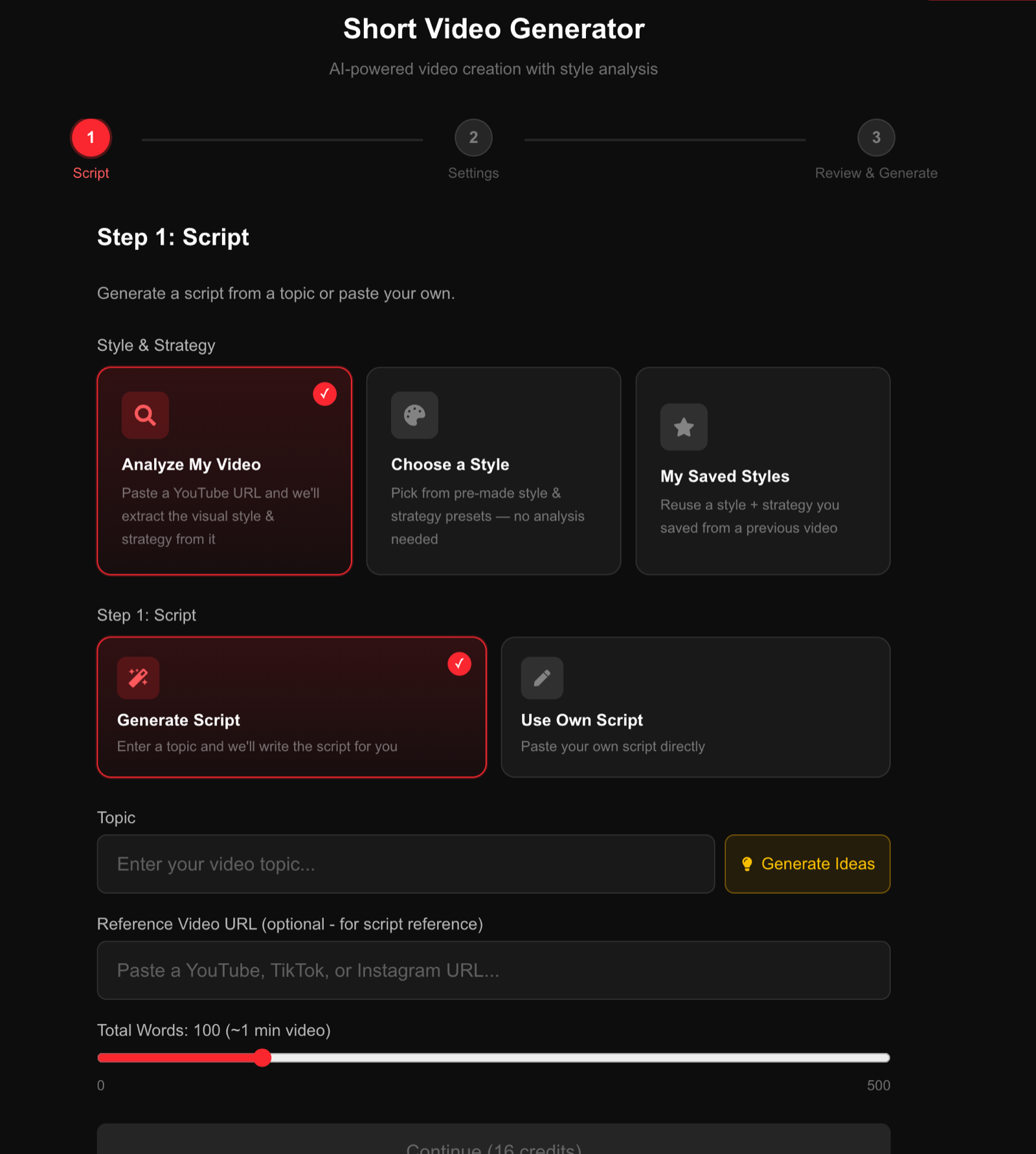
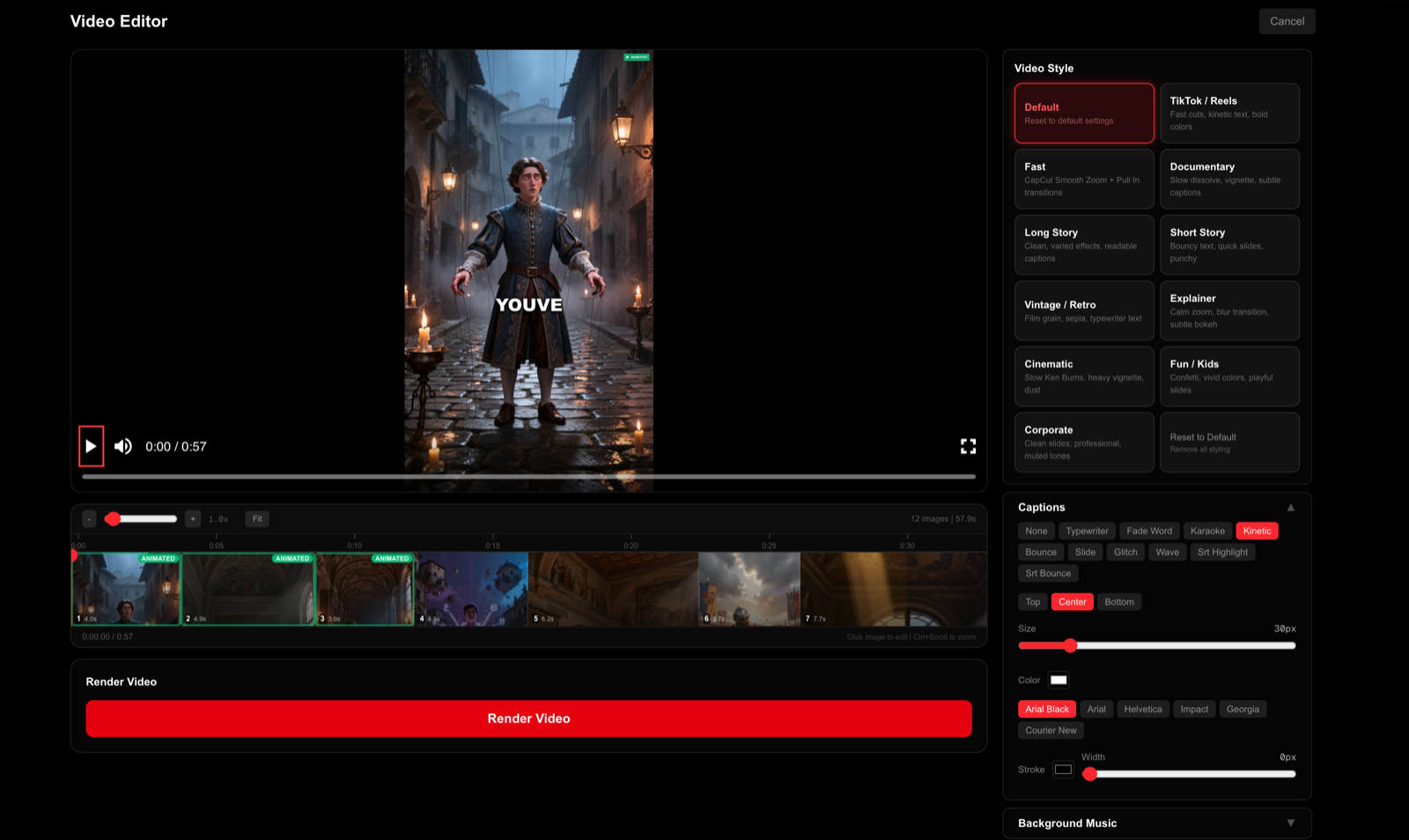
This is where the tooling matters. DirectAI handles the entire production pipeline from a single topic input: script, voiceover in 30+ voices and 12 languages, visuals, captions, and background music, all generated in about three minutes. You can review and adjust the result in a built-in editor, then export and upload directly.
The editor gives you control over visual style presets, caption styling, and background music without requiring any manual editing skills.
Publish your first faceless video today
DirectAI generates a complete faceless video from a single topic input. Script, voiceover, visuals, captions, and music, ready in about 3 minutes.
Create Your First Video →Finding Topics That Already Work
Picking the wrong topics is the most common reason new channels stall. You can do keyword research manually using YouTube's search suggestions, Google Trends, and tools like TubeBuddy or VidIQ. A reliable framework:
- Search your target keyword in YouTube. Look at the view counts on the top results. If the top videos have millions of views, it is a proven topic but competitive. If they have a few hundred thousand, there may be room for a well-optimized new video.
- Look at what questions come up in competitor comment sections. Comments like "can you do a video on X" are free topic ideas from an already-engaged audience.
- Check which videos have the highest view-to-subscriber ratios on competing channels. A video with 500,000 views on a channel with 30,000 subscribers is a clear signal that the topic has broad demand beyond the existing audience.
DirectAI's Creator Library takes this further by systematically tracking winning faceless channels across YouTube, TikTok, Instagram, and Facebook, and flagging viral outliers within each channel's catalog.
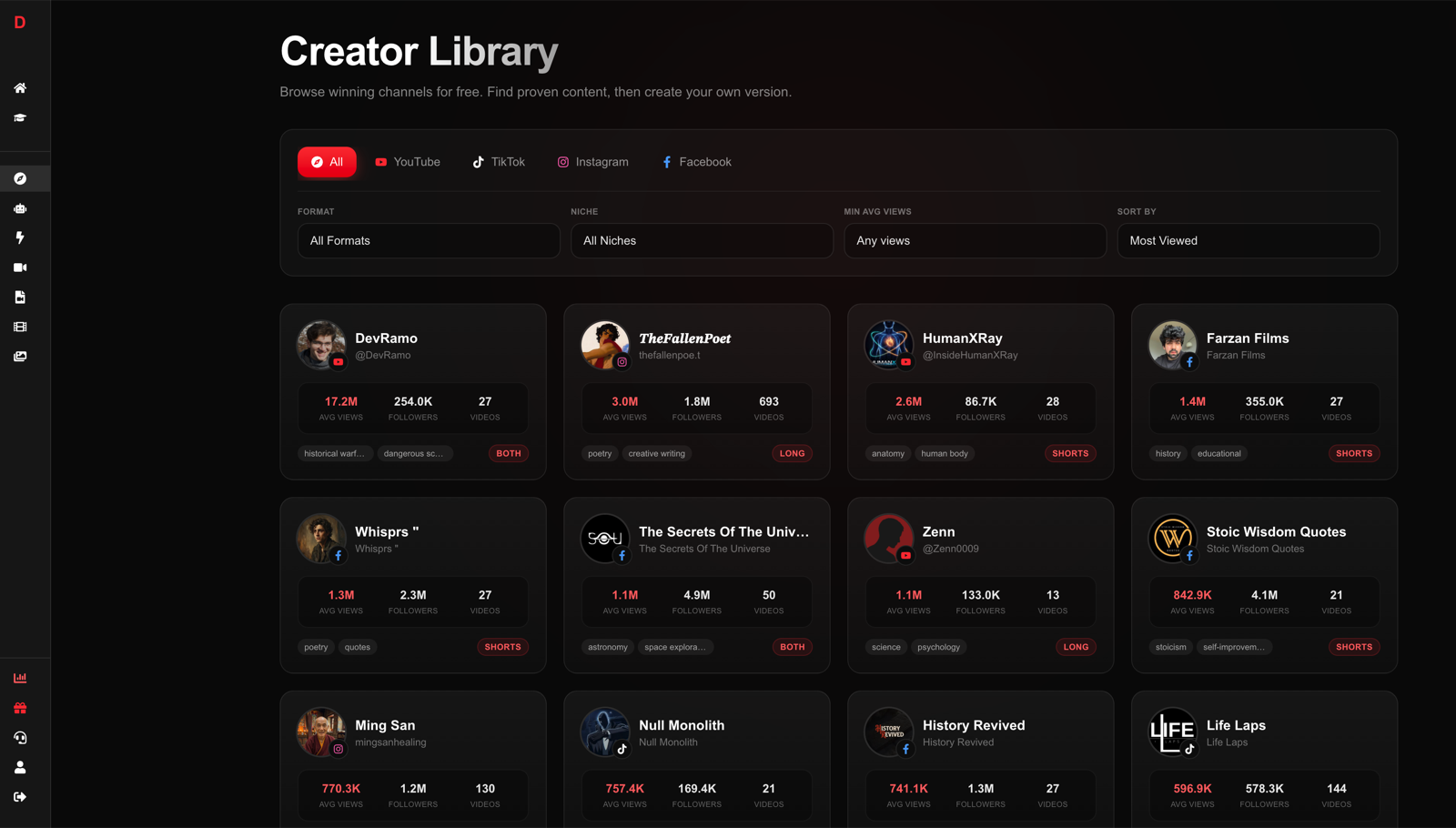
Once you find a video that performed well, the channel page shows that video's stats alongside a "Create Similar" button. Clicking it loads the video's style and structure into the generator so you can apply it to a new topic without having to rebuild your format from scratch.
What Realistic Earnings Look Like in Year One
Honest projections are difficult because results depend heavily on niche, posting frequency, audience geography, and how well your thumbnails and titles perform. That said, some general patterns hold:
- AdSense alone rarely covers full-time income in year one unless you are in a high-CPM niche and growing quickly
- Channels that layer AdSense, affiliate links, and one digital product typically earn two to three times more per 1,000 views than AdSense-only channels
- The fastest-growing faceless channels in 2025 and 2026 are posting four or more times per week and optimizing titles and thumbnails based on data, not instinct
- Consistency beats optimization in the early months. A channel with 150 videos and average thumbnails will outperform one with 20 polished videos in almost every case
For the operational side of setting up your channel correctly from the start, how to start a faceless YouTube channel covers the full setup process in detail.
FAQ
How to make money on YouTube without showing your face?
The main paths are AdSense through the YouTube Partner Program, affiliate links in video descriptions, brand sponsorships, digital product sales, and channel memberships. Faceless channels use narrated voiceover with stock footage, screen recordings, or AI-generated visuals. Every monetization method listed here works without a face on screen.
How long does it take to monetize a faceless YouTube channel?
Most channels reach the 1,000 subscriber and 4,000 watch hour threshold in three to nine months. Publishing frequency is the biggest variable. Channels posting four or more times per week consistently reach the threshold faster than those posting once a week, because they accumulate watch time and search entry points faster.
What faceless YouTube niche pays the most?
Personal finance, investing, real estate, and technology tend to have the highest CPMs, commonly $10 to $30 per thousand views. These niches attract advertisers paying premium rates to reach financially active audiences. Entertainment and motivational content earns less per view but can achieve much higher view counts.
Do you need expensive equipment to run a faceless YouTube channel?
No. Faceless channels rely on stock footage, screen recordings, or AI-generated visuals, none of which require a camera, microphone, or studio. The entire production pipeline can run on a standard laptop using tools like DirectAI, which handles script, voiceover, visuals, captions, and music in a single workflow.
Can you make money on YouTube without 1,000 subscribers?
Yes. Affiliate links in your video descriptions and sponsorship deals have no platform-imposed minimums. You can earn affiliate commissions from your very first video if it generates views. AdSense and channel memberships require meeting YouTube's Partner Program thresholds before they become available.