
Is YouTube Automation Legit as a Business Model?
The short answer: yes, but not in the way most people selling courses about it describe. YouTube automation, running channels where AI or hired writers, voiceover artists, and editors produce content without you appearing on camera, is a real and documented way to earn money online. The question worth asking is not whether it exists but whether it works at the scale and speed the people selling $997 courses claim.
Let me be direct about what the evidence actually shows, what the realistic downsides are, and who this model genuinely suits.
What "YouTube Automation" Actually Means
The term gets used loosely. At its core, YouTube automation means building a faceless channel where content production does not depend on your time or appearance. The spectrum looks like this:
- Manual outsourcing: You hire freelancers for scripts, voiceover, editing, and thumbnails. You act as a project manager.
- AI-assisted production: You use AI tools to generate scripts, synthetic voices, stock footage sequences, and captions. You review and post.
- Fully automated pipelines: Some operators string together multiple tools so that a topic input yields a near-finished video with minimal human review.
All three are legitimate in the sense that real channels use them and real money flows through them. The YouTube automation complete guide covers the production mechanics in detail if you want the full picture.
The Course-Seller Problem
Here is the part Reddit actually gets right. A significant portion of content about YouTube automation is produced by people whose primary income is selling courses about YouTube automation. That creates an obvious incentive to overstate earnings and understate difficulty.
Common misleading claims you will encounter:
- "Make $10,000 a month on autopilot in 90 days"
- Screenshots of Adsense dashboards with no channel age, niche, or CPM context
- Claims that you need no experience and minimal starting budget
The reality check on each:
| Claim | What the numbers actually suggest |
|---|---|
| $10K/month in 90 days | Possible for a small minority; most channels take 12-18 months to hit monetization, let alone significant revenue |
| Passive income from day one | Channels require active management, especially early on, for SEO, thumbnail testing, and content strategy |
| No experience needed | You need to learn platform mechanics, audience retention, and at minimum quality control |
This does not mean the model is fraudulent. It means the course market around it is noisy and you should weight claims by people who show long-term channel analytics, not single paycheck screenshots.
What Reddit Gets Right (and Wrong)
Reddit communities around YouTube automation tend toward two camps: true believers citing their first monetization check, and skeptics dismissing the whole thing as a pyramid scheme. Both oversimplify.
Where Reddit is right:
- Most people who start channels quit before they hit the YouTube Partner Program threshold, which requires 1,000 subscribers and 4,000 watch hours (or 10 million Shorts views).
- Niche selection matters enormously. A finance channel in a high-CPM niche earns very differently from a general entertainment channel. The RPM differences by niche can range from under $2 to over $20.
- Many people spend money on courses before they spend time understanding the platform.
Where Reddit often misleads:
- "It's all saturated" is not a complete analysis. Saturation applies to generic topics executed generically. Specific angles, underserved audiences, and strong retention still break through.
- The loudest voices are usually people who failed quickly, not people quietly running mid-sized channels earning $2,000 to $5,000 per month. Survivorship bias runs in both directions on forums.
Who Actually Makes Money With This Model
Based on what is publicly observable from channel analytics and creator disclosures, the people who make YouTube automation work share a few traits:
- They treat it as a business with a 12-24 month horizon, not a 90-day sprint.
- They pick niches with documented advertiser demand, not just what they personally find interesting.
- They study what already works before producing anything. This means analyzing existing channels, not just guessing at topics.
- They iterate on thumbnail and title performance rather than assuming quality content is enough.
- They reinvest early revenue into better production rather than pocketing it immediately.
None of this is exotic. It is standard small business thinking applied to a content platform.
Skip the research phase and start producing
DirectAI generates complete faceless videos, script, voiceover, visuals, captions, and music, in about 3 minutes. The Creator Library shows you which channels and topics are already working so you can model what converts before you post your first video.
Try DirectAI Free →The Role of AI in Making This More Accessible
The outsourcing model for YouTube automation used to require meaningful upfront budget. Paying freelancers for scripts, voiceover, and editing on a per-video basis adds up quickly before you have any revenue to offset it.
AI tools have changed that cost structure. A complete faceless video that would have cost $150 to $300 in freelancer fees can now be produced for a fraction of that. The tradeoff is quality control: AI-generated content still needs human judgment on topic selection, hook strength, and factual accuracy.
DirectAI takes the production side down to roughly 3 minutes per video, generating the script, a voiceover from 30+ voices across 12 languages, stock visuals, captions, and background music in one pass. The Creator Library component is where the research angle matters: it tracks winning faceless channels across YouTube, TikTok, and Instagram, flags viral outliers, and puts a "Create Similar" button on every video so you can clone a proven style onto a new topic rather than guessing at what formats work.
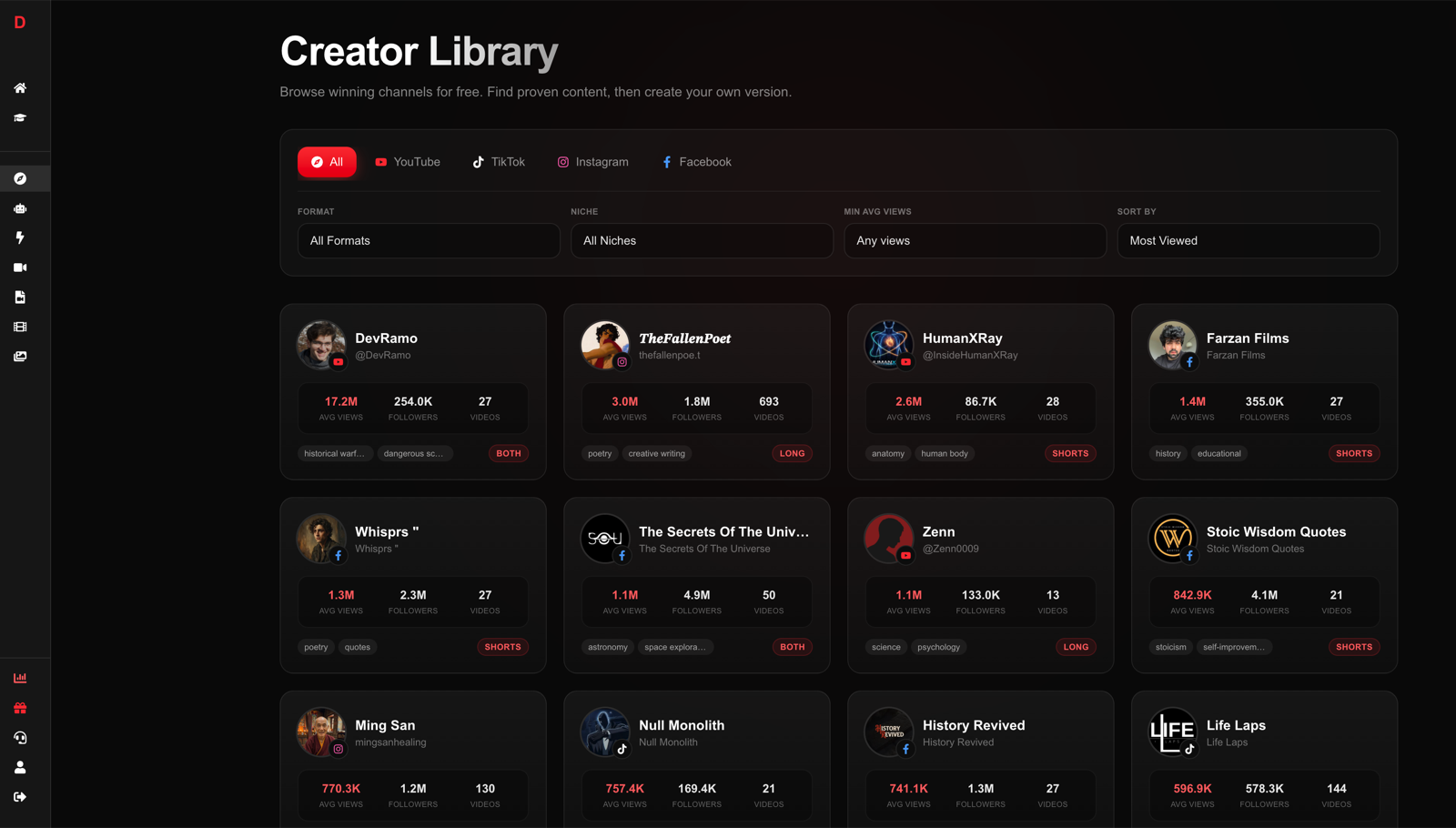
That kind of research infrastructure used to require manually watching hundreds of competitor videos. If you want to understand which formats and niches are genuinely producing results right now, that visibility matters.
Realistic Expectations for New Channels
Here is an honest timeline based on how the platform actually works:
- Months 1-3: Building content library, no monetization. Focus on retention rate and click-through rate feedback from YouTube Studio.
- Months 4-9: Approaching or hitting YPP requirements if posting consistently (2-4 videos per week in most niches).
- Months 10-18: First meaningful ad revenue. CPM and RPM vary widely by niche and audience geography.
- Year 2+: Channels that survive this long with consistent output often see compounding growth from older video performance.
The channels that fail usually do so in months 1-3 because results feel slow relative to the effort, or the operator did not do enough upfront research on niche viability.
For those exploring faceless channel structures before committing to YouTube specifically, it is worth reading about how to start a faceless YouTube channel and also considering whether short-form platforms fit your timeline better given their lower monetization barriers.
Is YouTube Automation Worth Starting in 2026?
The platform is more competitive than it was in 2020 or 2021. That is true. But YouTube's total watch time continues to grow, and the YPP has expanded to include Shorts monetization, which lowers the barrier for channels that produce vertical content well.
The honest assessment: YouTube automation is worth starting if you are willing to treat it as a medium-term project, invest time in niche research before producing, and measure your progress against retention and CTR data rather than just subscriber counts. It is not worth starting if you are expecting income within 60 days or are relying on a course that promises specific dollar amounts.
The model works. The timelines sold by most course creators do not.
FAQ
Is YouTube automation against YouTube's terms of service?
No. YouTube's terms do not prohibit outsourced or AI-assisted content. What they do prohibit is repetitive, low-quality content uploaded at scale with no editorial value (sometimes called "spam"). Faceless channels with genuine informational or entertainment value are allowed and common.
Is YouTube automation legit as a way to make passive income?
It can become relatively passive once a channel is established and a production system is in place. Early on it requires active management. "Passive" is more accurate at month 18 than at month 2.
How much money can you realistically make with a YouTube automation channel?
This varies too much by niche, CPM, and channel size to give a single number. A monetized channel with 50,000 monthly views in a mid-CPM niche might earn $100 to $400 per month in ad revenue. Channels with 500,000+ monthly views in high-CPM niches can earn several thousand dollars monthly. Neither outcome is guaranteed.
Do you need to buy a course to start YouTube automation?
No. The platform mechanics, niche research methods, and production workflows are documented across free YouTube videos, forums, and blog posts. Courses can compress the learning curve but are not required, and many oversell results.
What niches work best for YouTube automation channels?
High-advertiser-demand niches tend to produce the best CPMs: personal finance, business, technology, health, and legal topics. See the faceless YouTube niches ranked by CPM breakdown for a more detailed comparison.